Fly-Drive Holidays
Sample itineraries
Spectacular Utah - (Inc the World's first Dark Sky Park)
From £1575
On this colourful tour of Utah you'll explore Zion, Bryce, Capitol Reef, Canyonlands and Arches National Park. No less than five of America's most unusual and fascinating National Parks blanket Utah with spectacular scenery and unique collections of landforms.
Highlights:
- Zion National Park
- Bryce Canyon National Park
- Capitol Reef National Park
- Canyonlands National Park
- Arches National Park
- US Route Scenic By-Way
- Robert Redford's Sundance Resort
- Valley of the Gods
- Hovenweep National Monument
- Monument Valley
- Historic Temple Square & Salt Lake Temple (home to Tabernacle Choir)
- INCLUDES WORLD'S FIRST INTERNATIONAL DARK SKY PARK-one of the best viewing areas in the USA for the Milky Way.
Price per person includes:
- Return flights to Salt Lake City, Utah
- All taxes
- 11 night’s accommodation in lodges, resorts and unique hotels
- 12 days mid size car hire
- A personalised road book which is a complete guide to travelling within North America and provides bespoke driving instructions for your holiday.
Ideal time to visit: Late April to early November
Prices are based on off-season travel. Please call or email for costs for your preferred date of travel.
Day 1 Salt Lake City
Salt Lake City lies in a mountain valley with a dramatic backdrop of the Wasatch Mountains to the east and north and the Oquirrh Mountains to the west. Sitting at 4,330 feet above sea level, Salt Lake City is situated on land once covered by the prehistoric Lake Bonneville. This ancient lake once sat atop a mountain plateau in portions of Utah, Nevada and Idaho at between 4,200 feet to 5,200 feet. The eastern and northern portions of the city are located on a series of terraces or former beaches, known locally as 'the benches'.
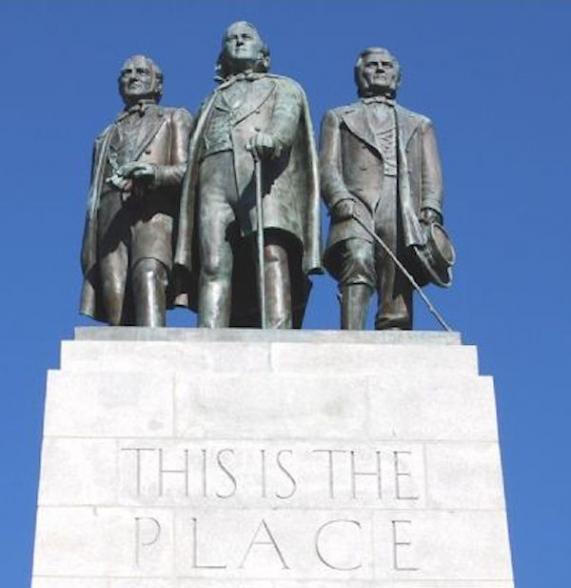
No one should leave Salt Lake City without seeing Historic Temple Square, the beautifully landscaped 10 acre park that surrounds the six spired Salt Lake Temple. The famous domed Tabernacle, home to the world renowned Mormon Tabernacle Choir is also on the square. Free concerts occur on most weekends and you can listen to rehearsals on Thursday evenings. Organ rehearsals are also open for listeners.
A Visit Salt Lake Connect Pass lets you visit any or all of the prime attractions in Salt Lake City including Utah Olympic Park, Utah Museum of Natural History, Utah Museum of Fine Arts, Clark Planetarium, Discover Gateway, the Living Planet Aquarium, the Zoo and Red Butte Garden. Pick and choose as you like for today and tomorrow.
Accommodation: Little America Hotel or similar
Day 2 Provo
Distance: 50 miles
Every one has to have a bit of relaxation time and we have planned yours at Robert Redford’s Sundance Resort just south of Salt Lake City in Provo. The setting invites you to “come stay with us, watch the moon climb over Utah’s Mt. Timpanogos from your Sundance patio and enjoy a fireside dinner in your mountain home.” You can retreat where centuries ago the Ute Indians retreated to escape the summer heat and enjoy the natural abundance. As Robert Redford says about his very special resort, “this place in the mountains is the perfect host for inspiration.”
Accommodation: Sundance Resort or similar
Day 3 Capitol Reef National Park
Distance: 206 miles
From Sundance, it’s on to your first Utah National Park. Capitol Reef was named by early pioneers for the formations that reminded them of the nation’s capitol. Starting from the Capitol Reef Visitors Centre, the Waterpocket Fold, the Park’s main feature, a 100-mile long “wrinkle” in the earth’s crust, extends out from Thousand Lakes Mountain to the Colorado River. Travelling the Park’s Scenic Drive, you’ll marvel at the slip rock scenery, punctuated with coloured cliffs, domes, canyons and arches. The classic “monocline,” where the fold is very steep on one side and a series of horizontal layers on the other, is a continuation of the “stepping up” rocks that you will encounter further south. Also on display are artefacts, historic orchards, the old Fruita Schoolhouse and other structures from the nearby Fruita pioneer settlement which began in 1872.
Accommodation: Skyridge Inn or similar
Day 4 Bryce Canyon National Park
Distance: 126 miles
Today, a portion of the Highway 12 National Scenic Byway is going to take you from Torrey to Bryce Canyon National Park. The section of the Scenic Byway, called the “Million Dollar Road to Boulder,” was built by the Civilian Conservation Corps. It was completed in 1935, but not paved until 1971. The roadway provided the first year-round access for cars to this isolated pocket of South western Utah. Before then, mail and supplies were carried by mules and pack horses over Hell’s Backbone or the Boulder Mail Trail, both hazardous routes. Highway 12 winds through vast expanses of “slick rock” country including part of the Escalante Canyons and other popular hiking areas. Pullouts along the route enable you to view the Escalante Basin, the Henry Mountains and other awesome scenery.
Passing the Calf Creek Recreation Area, the drive climbs Haymaker Bench and crosses the Hogback, a ridge with steep drop-offs on both sides. The road is very narrow at the top, twisting through Dixie National Forest and across Boulder Mountain. The section of road between Boulder and Torrey was paved in 1985. Part of the Aquarius Plateau, Boulder Mountain exceeds 11,000 ft. and is the highest timbered plateau in North America. Closer to Bryce, the route then climbs past a rocky section with unusual clay coloured hills, called “The Blues.”
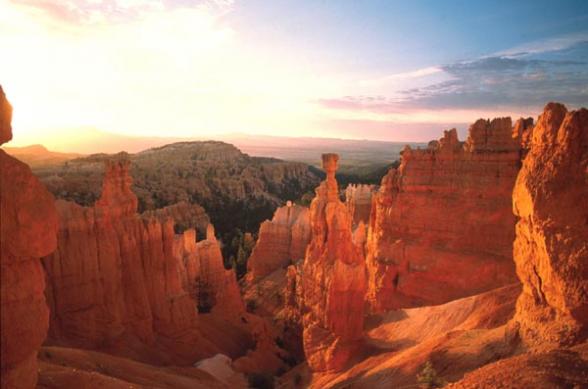
Bryce Canyon National Park, named after the Pioneer Ebenezer Bryce, became a national park in 1924. Famous for its unique geology, the Park is not really a canyon, but a series of horseshoe shaped amphitheatres carved from the eastern edge of the Paunsaugunt Plateau.
Accommodation: Bryce Canyon Lodge or similar
Day 5 Bryce Canyon National Park
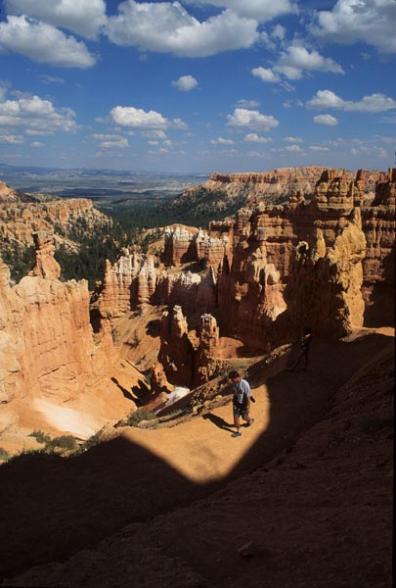
The eroding force of frost coupled with the dissolving power of rainwater has shaped the colourful limestone rock of the Claron Formation into bizarre shapes including slot canyons, windows, fins and spires called "hoodoos." Tinted with colours too numerous and subtle to name, the whimsically arranged rocks create a wondrous landscape of mazes, offering some of the most exciting and memorable walks and hikes imaginable. The Ponderosa pines, high elevation meadows and firspruce forests border the rim of the plateau are alive with wildlife.
This area which boasts some of the world's best air quality offers a panoramic view of three surrounding states and nearly 200 miles. This phenomenon, coupled with the lack of nearby large light sources, creates an unparalleled opportunity for stargazing.
As with most National Parks, your first stop should be at the Bryce Canyon Visitors Centre to get an overview of the Park. There are times in Bryce when everyone is required to use the shuttle. A Geology Talk about the “hoodoos,” ancient lakes and frost wedging is given each day at either Inspiration or Sunset Point. A ranger-led one mile round trip on the Rim Walk lasts about an hour and a half and delivers great views, fascinating plant and wildlife stories, a touch of geology, and a smattering of cultural history.
Accommodation: Bryce Canyon Lodge or similar
Day 6 Zion National Park
Distance: 99 miles
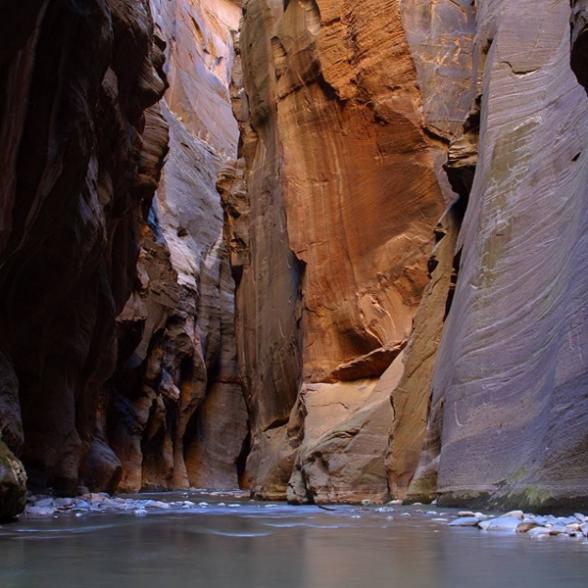
Once you get to Zion, you’ll quickly understand why a writer experiencing Zion said, “It is here that the grandeur of the natural form unites with brilliancy of colour.” From sunrise to sunset, the changing scenes pass before you in awesome hues. Be sure to watch as light plays upon the rock, immersing you in a dazzling light show. You are surely in one of Mother Nature’s masterpieces.
Zion National Park is located along the edge of a region known as the Colorado Plateau. As you travel between the Grand Canyon and Zion National Park and on to Bryce Canyon, the rock layers are a series of stair steps referred to as the Grand Staircase. The bottom layer of rock at Bryce Canyon is the top layer at Zion and the bottom layer at Zion is the top layer at the Grand Canyon. At the land in the area transformed, each layer of rock was created from a different type of material. The ancient sea beds became limestone, mud and clay became shale and desert sand became sandstone.
There is a free shuttle that travels throughout the park and stops at eight locations. The transfer of passengers between loops is made at the Zion Canyon Visitor Centre. You may get on and off the shuttle as often as you like. You can also visit the Zion Human History Museum, a regular stop on the Zion Canyon Shuttle. Permanent exhibits display the rich human history of Zion National Park, showcasing American Indian culture, the historic pioneer settlement, and Zion's growth as a National Park. The Human History Museum also illustrates the effects of water on Zion, both as creator and destroyer. In addition, a 22-minute video, shown every half hour, provides an excellent overview. There is another Visitor Centre at Kolob Canyon.
Accommodation: Zion Lodge or similar
Day 7 Monument Valley
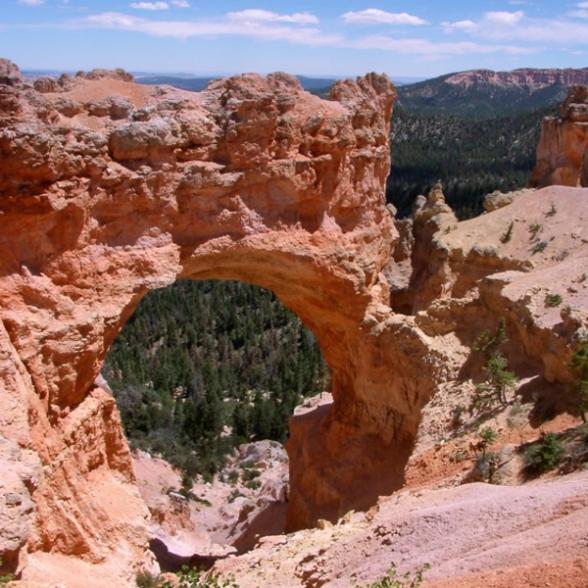
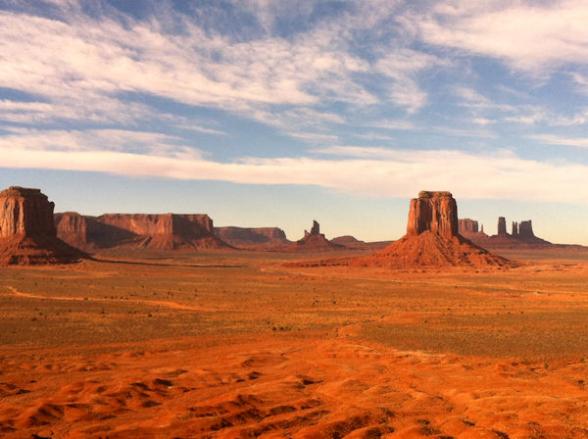
Monument Valley has a series of spectacular landscapes, yet each is completely different from the other geological formations in the area. In 1883, prospector Cass Hite wandered up White Canyon from his base camp along the Colorado River in search of gold. Instead he found three magnificent bridges sculpted from sandstone that was publicized by National Geographic Magazine in 1904. In 1908, President Theodore Roosevelt established Natural Bridges National Monument, creating Utah’s first National Park Service affiliate. When the park was expanded to protect nearby Puebloan structures, the General Land Office assigned the Hopi names of “Sipapu,” (place of emergence), “Kachina” (reflecting the rock art on the bridge) and “Owachomo” (rock mound). A nine-mile scenic loop starting and ending near the Natural Bridges Visitor Centre overlooks each of the bridges. A trailhead for each bridge is also located along the drive.
Valley of the Gods is a red dust landscape punctuated with silver-green brush. The valley, lying at the base of a 1,200 foot bluff is called Cedar Mesa. The area’s jagged towers, gravelly washes and tortured sandstone formations line the Valley of the Gods Road, a 17-mile dirt route that forms a scenic loop. Each bend in the road reveals a surprise, a slightly different shade of red or a new rock contortion, many of which are described in Navajo legend as ancient warriors frozen in time.
The Hovenweep National Monument protects six Puebloan-era villages spread out over a 20-mile expanse of mesa’s and canyons on the Utah-Colorado border. The Square Tower Group, with multi-storeyed towers perched on canyon rims and balanced on boulders, serves as the primary contact facility with a Visitor Centre and Interpretive Trail. Take time to explore and marvel at the skill of these ancient builders.
Accommodation: The View Hotel or similar
Day 8 Bluff, Utah
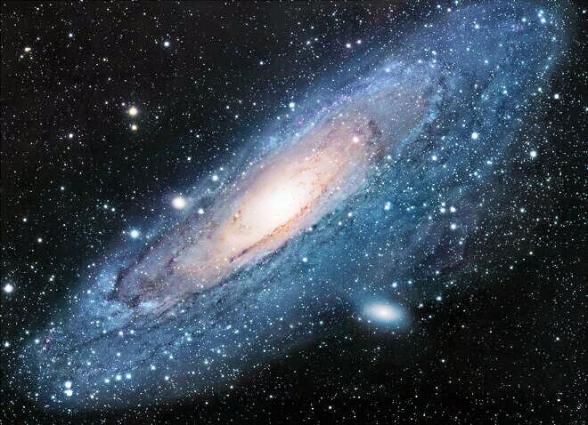
Imagine seeing the Milky Way galaxy in such incredible clarity that is appears three dimensional, like a river of millions of stars and planets flowing above you. this is exactly what you will experioence this evening at Natural Bridges National Monument, which has been designated the world's first "International Dark Sky Park" by the International Dark Sky Association. Not surprisingly, it is an absolute mecca for star gazers.
During the day the park offers up some of the southwest's most spectacular natural stone architecture, including its namesake natural bridges, and awe-inspiring sandstone canyons. Hiking trails and an 8.6 mile scenic drive allow visitorsa closer exploration of these wonderful structures. By night, Rangers specially trained in astronomy advise visitors on the best opportunities for star gazing. These "Dark Rangers" also educate the public about the effects of light pollution on humans, plants and animals, and how we can all make a positive difference.
Your accommodations for tonight are a short drive away in Bluff, so take your time enjoying the truly amazing celestial light show.
Accommodation: Desert Rose Inn or similar
Day 9 Moab
Distance: 176 miles
Canyonlands National Park is one of the last relatively undisturbed areas of the Colorado Plateau, a geological province that encompasses much of the Colorado River and its tributaries. Carved out of vast sedimentary rock deposits, this landscape of canyons, mesas, and deep river gorges possesses remarkable natural features that are part of a unique desert ecosystem. The foundation of Canyonlands' ecology is its remarkable geology, visible everywhere in cliff profiles that reveal millions of years of deposit and erosion.
Between Blanding and Moab, you’ll be able to explore The Needles District, the first accessible Portion of Canyonlands National Park. In this relatively remote area, the roads between the two portions of the park do not connect with each other. The park is known as "high desert," with elevations ranging from 3,700 to 7,200 feet above sea level. Temperatures may fluctuate as much as 50 degrees during a day.
Accommodation: Red Cliffs Lodge or similar
Day 10 Moab
Distance: 234 miles
Leaving from Moab you’ll be turning slightly back southwest to reach Island in the Sky, the largest portion of Canyonlands National Park open to visitors. Island in the Sky offers the most expansive views from overlooks along the paved scenic drive. Many overlooks are perched 1,000 feet above the surrounding terrain, providing spectacular views of the canyons below. Several short trails including Mesa Arch, Upheaval Dome and Aztec Butte, lead to interesting natural and cultural resources. A drive out to Grand View Point gives you access to an area evident by its name. An orientation video at the Island in the Sky Visitors Centre highlights the geology of the Park.
Accommodation: Red Cliffs Lodge or similar
Day 11 Salt Lake City
Spend one more day exploring Salt Lake City.
Accommodation: Little America Hotel or similar